
The Midterm Challenge
Summary:
Earnings support the broader market: Strong profit growth and broader sector participation continue to underpin the bull-market case, although beating estimates alone is increasingly insufficient.
AI faces tougher scrutiny: Demand remains strong, but investors are paying closer attention to capital spending, financing and cash generation. The next phase is likely to reward greater selectivity.
Politics and rates remain important: Tuesday’s US midterms, Thursday’s Bank of England decision and Friday’s US employment report will test the balance between resilient growth and persistent inflation.
October concealed considerable divergence: UK equities and bonds gained, while Japan and emerging markets suffered larger falls. The article distinguishes local-currency equity returns from sterling and sterling-hedged bond returns.
Consolidation remains the base case: Tom sees the recent weakness as a correction within an ongoing bull market, while recognising that policy uncertainty, yields and demanding valuations could sustain volatility.
Full Market Insight
Markets enter November with three issues to contend with: the US midterm elections, a very strong earnings season, and a sharp reset in parts of the technology trade. That combination has unsettled sentiment, but it has not yet broken the broader bull-market case. October was a good reminder that calm headline returns can hide a lot of churn underneath. The FTSE 100 and global bonds produced respectable gains over the month, yet the S&P 500 slipped, Japan weakened, and emerging markets fell sharply. Beneath the surface there was a clear change in leadership away from the most crowded growth and momentum trades.
Overview
The immediate focus is Tuesday’s US midterms. These elections do not attract the same global attention as a presidential race, but they matter for fiscal policy, regulation and, by extension, bond yields. Polling points towards Democratic gains, with the House the more plausible switch and the Senate also competitive. Investors are therefore thinking less about a single outcome and more about what any new Congressional balance means for spending, taxes, industrial policy and the regulatory backdrop.
At the same time, the earnings backdrop remains strong. With roughly 60% of S&P 500 companies having reported, about 82% have beaten earnings estimates and blended year-on-year earnings growth stands at 30.2%, putting the index on course for a third straight quarter above 25%. That is a powerful support for equities. The problem is that the market is no longer rewarding good results automatically, especially in large-cap technology. Investors still like the demand story around AI, but they are now much tougher on capital spending, free cash flow and financing.
US
The political question for markets is straightforward. Democratic control of one or both chambers would mean divided government, probably bringing more gridlock and less scope for major fiscal initiatives. Bond investors have often been comfortable with that outcome because it can reduce fears of further spending expansion. Democratic control of both chambers would increase scrutiny of taxation and regulation, but major legislative changes would still require agreement with the Republican White House. A Republican hold, meanwhile, would preserve policy continuity but would keep alive concerns about looser fiscal settings.
The economic backdrop is still firm. Third-quarter US real GDP grew at an annualised 3.4%, the labour market has held up better than many expected, and business investment remains supportive. That helps explain why the Federal Reserve continues to sound cautious. Rates were left unchanged at the last meeting, but policymakers are not yet in a position to declare victory on inflation. The pause does not mean the inflation problem is solved, and the Fed has given little encouragement to expectations of an imminent cut.
The earlier rise in bond yields had already done part of the tightening work. Financial conditions had become less supportive as long-dated Treasury yields rose, equities became more volatile and credit markets grew more selective. The late-week rally in Treasuries eased some of that pressure, but the broader message remains that markets are adjusting to a world in which rates do not quickly return to the ultra-low norms of the last cycle. For investors, the key point is that a 10-year Treasury yield near 5% changes the valuation debate, especially for long-duration growth assets.
Earnings
If there is one reason not to become too negative, it is profits. Earnings are still doing the heavy lifting. Sales growth remains healthy, margins have been more resilient than feared, and the breadth of earnings growth has improved. This is not a market being held up by one narrow pocket of strength. Several sectors are contributing, even if technology continues to dominate the headlines.
That said, this season has also underlined a change in investor behaviour. Beating estimates is no longer enough on its own. The size of earnings surprises has been modest, and management guidance matters much more than it did earlier in the year. Companies that are asking shareholders to fund another leg of heavy investment need to show a clearer path to returns. In other words, the market has moved from a ‘hopes and dreams’ phase to more of a ‘show me’ phase.
Technology and AI
This is where the recent correction has been sharpest. The Nasdaq Composite is down 7.8% in US-dollar price terms from its 6 October closing peak, which is uncomfortable but not unusual for a volatile index. More notable has been the decline in the Invesco S&P 500 Momentum ETF relative to the S&P 500 since late June, as the accompanying chart shows. That is consistent with a sharper reversal among recent market leaders than across equities as a whole.
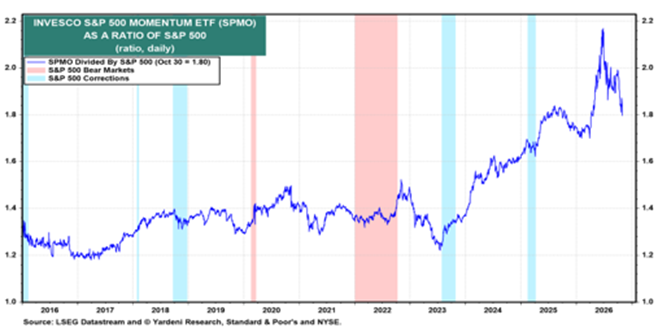
Source: LSEG Datastream and Yardeni Research. Invesco S&P 500 Momentum ETF (SPMO) relative to the S&P 500, scaled by 100; daily US-dollar prices, 2015–30 October 2026, excluding dividends. A falling ratio indicates relative underperformance.
The immediate triggers are familiar. Intel’s outlook disappointed badly, despite a stronger third quarter. Alphabet and Amazon both reinforced concerns that the cash demands of AI investment are running ahead of what investors want to tolerate. The issue is not that AI demand has disappeared. If anything, the evidence on demand for advanced chips, memory and cloud capacity remains strong. The issue is that the market is no longer willing to ignore the bill.
Microsoft offered a useful counterweight: Azure revenue grew 48% year on year and quarterly free cash flow was $18.6 billion, despite heavy capital spending.
In my humble opinion, we are not witnessing the beginning of an ‘AI apocalypse’, but rather a reassessment of valuations and financing conditions following an extraordinary period of investment and enthusiasm. The longer-term potential for AI to deliver substantial productivity gains across the global economy remains compelling, but the infrastructure required is enormously expensive, energy-intensive and will take time to deliver. Perhaps the key question is just how patient investors are prepared to be. The chief executives committing hundreds of billions of dollars to this transformation are thinking three or five years ahead, while financial markets tend to judge their progress one quarter at a time. Those different time horizons could bring further volatility, particularly as investors ask tougher questions about financing costs, cash generation and returns on investment. We suspect the next phase of the AI investment cycle will be more selective, rewarding businesses that can show a credible path from extraordinary capital expenditure to sustainable returns on that investment. The opportunity remains substantial, but the market’s patience may prove rather less so.
UK
For UK investors, the Autumn Budget deserved more attention than it received in global markets. The main relief was that it passed without causing a gilt-market problem. The government remained on course to meet its fiscal rules in the OBR’s forecast, and the market reaction was orderly. After the experience of recent years, UK investors are rightly sensitive to any sign that fiscal policy is drifting into territory that unsettles bond holders.
The economic backdrop remains uneven. Growth has been more resilient than the mood suggests, but inflation remains awkward and the Bank of England has little room to relax. Yet the UK market has held up relatively well because of its composition. Financials, energy, healthcare and large global earners have offered some insulation from the sell-off in expensive US technology. That does not make the UK an economic bright spot, but it does help explain why UK-listed equities have looked steadier than sentiment might suggest.
Europe, Japan and emerging markets
The euro area remains stuck between weak growth and sticky inflation. Political noise in France has not helped, and Christine Lagarde’s planned departure next year adds another moving part for the ECB. None of this is a crisis, but it leaves a challenging backdrop for European equities.
Japan has also had a softer spell. Markets are still adjusting to the idea that wage growth and inflation may keep the Bank of Japan on a tightening path, even if that path remains gradual. Higher domestic rates are a notable change after years of ultra-loose policy. Elsewhere, China and broader emerging markets had a difficult October. Weak confidence, uneven growth and a stronger US backdrop continue to limit enthusiasm.
Credit, bonds and commodities
The late-week move lower in bond yields was a useful reminder that government bonds can still diversify equity risk when sentiment wobbles. That is important after periods when inflation appeared to weaken the traditional balance between equities and bonds. Credit is sending a slightly different message. It is not broadly distressed, but it is becoming more discriminating, particularly towards businesses with heavy financing needs and uncertain payback periods. That is healthy in the long run, even if it creates short-term pressure in the most speculative parts of the AI complex.
This is not a general credit squeeze: broad US investment-grade and high-yield spreads were narrower over the week to Thursday, although those figures do not capture Friday’s sell-off.
The picture in commodities remains mixed. Energy prices still matter for inflation and consumer confidence, but they have not yet been enough to derail the wider growth story. Industrial demand indicators are patchy rather than collapsing. For now, commodities look more like a source of macro noise than the central driver of market direction.
October in context
The month-end numbers tell two stories. On the surface, they do not look too bad. The FTSE 100 rose 1.29%, UK conventional gilts added 1.54%, and global aggregate bonds hedged into sterling gained 1.70%. Underneath, though, there was a much rougher ride. In local-currency total-return terms, the S&P 500 fell 0.87%, Japan lost 3.95%, China dropped 7.13%, and emerging markets were down 7.44%. That is a decent summary of October: relatively contained losses for the broad US market and gains in the UK, but a much more difficult month for several other regions and parts of technology.
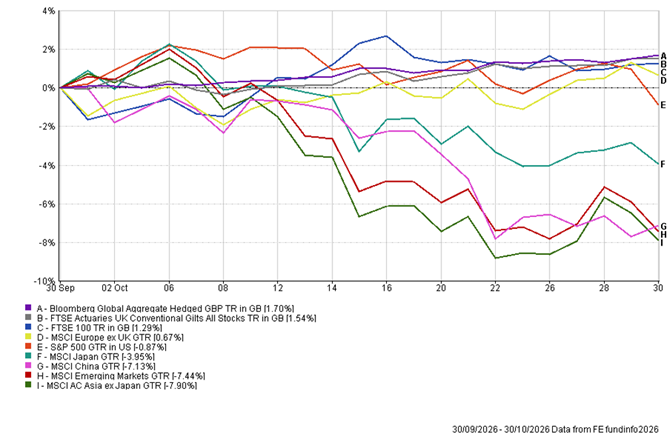
Source: FE fundinfo. Cumulative total returns, 30 September–30 October 2026. Equity indices in local currencies; UK gilts and FTSE 100 in sterling. Bloomberg Global Aggregate hedged to GBP. These are not uniform sterling investor returns.
This Week
The next few weeks should tell us whether this is simply a correction within an ongoing bull market or the start of something more serious. Alongside Tuesday’s midterms, Thursday’s Bank of England decision and Friday’s US employment report will test the balance between resilient growth and persistent inflation. Our base case remains the former. Earnings are strong, the US economy is still expanding, and the recent sell-off has been concentrated in the areas where valuations and expectations had run furthest. That does not mean volatility is over. The midterms could bring policy uncertainty, yields may remain choppy, and the market is clearly less forgiving than it was over the summer.
Even so, the bigger picture has not changed as much as the headlines suggest. The market has become less tolerant of expensive stories without near-term proof. That is a healthy development. It could encourage better discipline, broader leadership and a clearer distinction between durable beneficiaries of AI and those merely spending heavily in its name. After four years of a powerful bull run, a period of consolidation would be normal. It need not mean the bull market is finished.
DOWNLOADS
There are currently no downloads associated with this article.