
Yields return to 5%, but equities hold firm(ish)
As we said last week; September has lived up to its reputation for testing investors, but the damage so far has been surprisingly modest. Through 18 September, emerging markets and Asia ex-Japan were broadly flat, while the S&P 500 and FTSE All-Share were down only around 0.4%. Japan and the FTSE 100 were roughly 1.5% lower, Europe ex-UK was down 2.4%, and China was the clear laggard at close to 3.8% lower. There has therefore been a pickup in volatility, but nothing approaching a broad liquidation of risk assets.
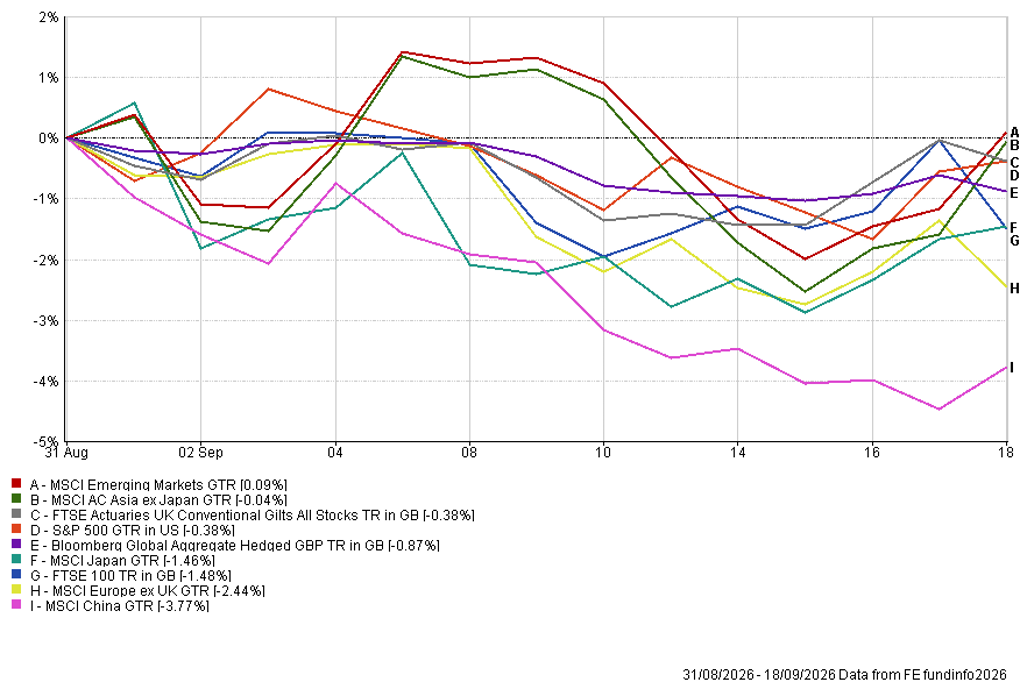
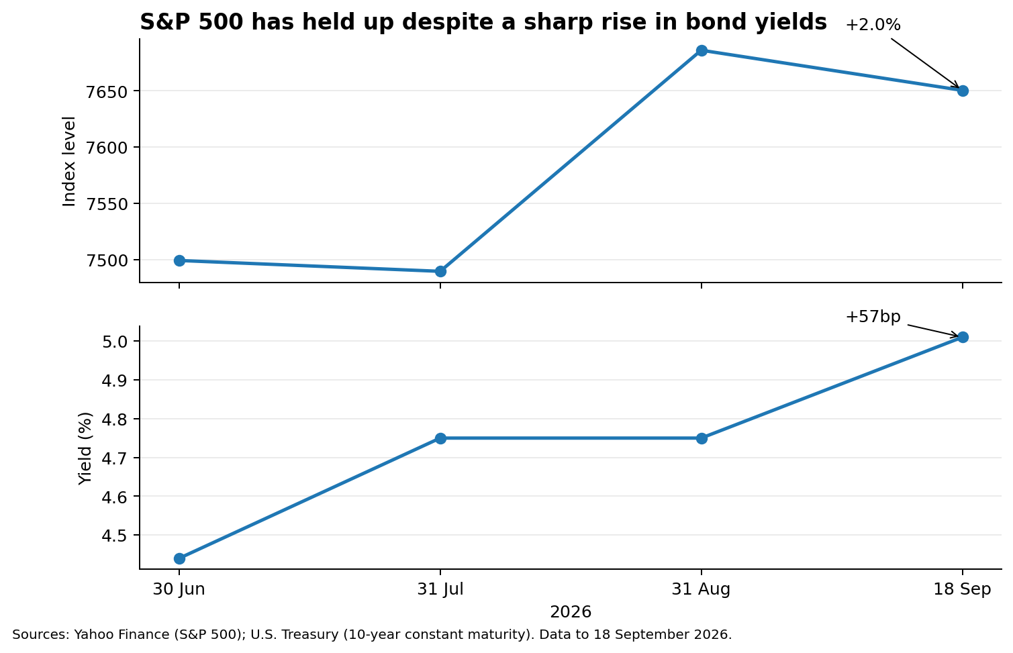
That resilience is striking because the backdrop has become considerably less friendly. Brent crude remains in the $104-105 area, the US 10-year Treasury yield has returned to around 5%, the Federal Reserve has raised rates for the first time in more than three years, the ECB has tightened again, and the Bank of Japan has decided to take its policy rate to a 31-year high.
Ordinarily, that combination would produce a much more obvious equity correction. It has not. The S&P 500 finished Friday at 7,650, almost flat on the week and still only around 2% below its August record high. The Nasdaq was actually higher over the week.
Earnings rise as the multiple falls
The most useful explanation for that resilience comes from earnings and valuation. Yardeni Research’s latest available series as at 18 September put S&P 500 forward operating earnings at a record $404.84, while the calendar-year 2027 consensus stood at $419.93. Against an index near 7,650, the market traded at approximately 18.9 times forward earnings. The corresponding multiples for the S&P 400 and S&P 600 were 15.1 and 14.3 times. In other words, earnings expectations have continued to move higher while investors have been prepared to pay a lower multiple for those earnings.
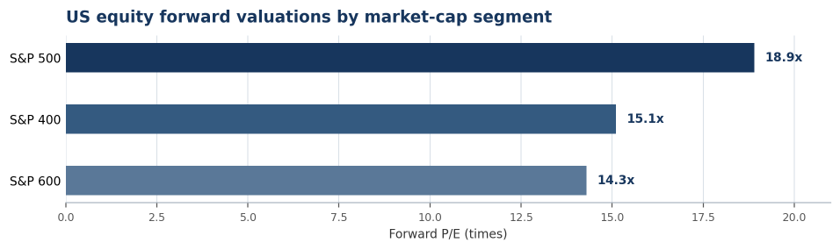
I think this is an important distinction. It challenges the view that the entire market is being driven by indiscriminate AI speculation. Classic bubbles are normally characterised by prices and valuation multiples rising together as investors increasingly extrapolate future growth. During the late-1990s technology boom, long-term earnings growth expectations and the market P/E rose together. The present pattern is different: earnings expectations are strong, but the multiple is compressing. That clearly does not make equities immune from a correction, and 18.9 times is hardly cheap. That does not give the AI complex a clean bill of health: earnings growth remains unusually concentrated, while the durability of hyperscaler capital expenditure, power availability and end-customer monetisation still needs to be demonstrated. It does, however, mean that some of the adjustment to higher yields has already happened without requiring a large fall in the index.
The next earnings season now matters more than usual. Analysts are currently looking for very strong second-half profit growth, and the bull case increasingly depends on those numbers being delivered. If earnings continue to rise, equities can absorb some further multiple compression. If earnings disappoint at the same time as bond yields remain around 5%, the cushion becomes much thinner.
Central banks are back in inflation-fighting mode
The Federal Reserve’s quarter-point increase to 3.75%-4.00% was widely expected by the time it arrived, but the detail was more hawkish than the headline. The 12-0 decision delivered the first increase in more than three years, and the new projections shifted materially higher. The median end-2026 policy-rate projection rose to 4.1% from 3.8% in June, consistent with roughly one further quarter-point increase, although the projections are conditional and do not constitute a policy commitment. The 2027 median also moved to 4.1% from 3.6%.
At the same time, the Fed nudged its growth forecasts higher and its unemployment forecasts lower: the median 2026 projections now show GDP growth of 2.3%, unemployment of 4.1%, headline PCE inflation of 3.7% and core PCE of 3.4%. In other words, the Fed sees an economy resilient enough to absorb tighter policy while inflation remains too high.
Warsh’s own message is also becoming clearer. At Jackson Hole he described 2% inflation as a firm target and argued that the better summer inflation readings had not yet shown a meaningful improvement in the underlying trend. He has deliberately stepped back from heavy forward guidance, preferring a quieter Fed and a less mechanical reaction function.
At last week’s press conference he argued that the rise in long Treasury yields reflects economic strength, heavy capital spending, particularly by AI hyperscalers, and geopolitical risk rather than a loss of confidence in the Fed’s inflation resolve. Longer-dated yields initially eased after the decision before returning to around 5% by Friday, while inflation breakevens remained below their recent highs. For now, markets appear to be giving the Fed some credit for showing that the 2% target is a constraint, not simply an aspiration.
Europe is facing much the same problem. The ECB lifted its deposit rate to 2.50% earlier this month as energy-driven inflation moved above 3%, and bond markets have increasingly priced the possibility of more tightening. German 10-year yields recently reached their highest level in 17 years. France adds a separate fiscal dimension: the French 10-year spread over Germany has exceeded one percentage point, its widest since the euro-area debt crisis, while the Finance Ministry expects public debt to reach 119.3% of GDP in 2026. The combination of higher energy costs, higher policy rates and weaker fiscal credibility is becoming a genuine differentiator within Europe.
In the UK, the Bank of England kept Bank Rate at 3.75%, but the emphasis remains firmly on inflation risk. The more interesting market development was the redesign of quantitative tightening. The Bank paused active gilt sales for six months and set out a slower run-off path to 2034. Gilts maturing in 2049 or later will no longer be sold actively; the remainder will run down through maturities and a reduced programme of shorter- and medium-dated sales. Thirty-year gilt yields fell sharply following the announcement. This does not remove the UK’s fiscal challenge, particularly with the Budget due on 28 October, but it does remove one technical source of pressure from a part of the gilt market that had become increasingly fragile.
Japan also moved in the opposite direction to the easy-money regime investors had become used to for decades. The Bank of Japan decided to raise its policy rate to 1.25%, effective 24 September, the highest level in 31 years. The hike itself was expected; the nuance was the 7-2 vote and Governor Ueda’s relatively cautious tone. The yen weakened after the announcement, underlining that markets had been positioned for a more uniformly hawkish message. Even so, Japan’s gradual policy normalisation remains relevant globally because it changes the economics of yen-funded carry trades and raises the hurdle rate for Japanese capital invested overseas.
Oil is still the swing factor
The largest single macro variable remains energy. Brent finished the week in the $104-105 area, still firmly above $100, after easing on reports that China had pressed Iran to restrain Houthi attacks on Saudi oil infrastructure. Saudi Arabia is also working to restore capacity on its East-West pipeline, which offers some alternative to the Strait of Hormuz. Those are constructive developments, but the shipping route through Hormuz remains heavily disrupted and the outlook is still highly uncertain.
For markets, the direction of oil from here matters more than almost any individual economic release. A sustained move back below $100 would ease pressure on headline inflation, give central banks more room to pause and support real household incomes. A renewed move higher would do the opposite and could force policy rates and bond yields further into restrictive territory. That is why equities have been so sensitive to each development in the Middle East, even while the underlying earnings picture remains strong.
China: domestic demand and trade risks
China has been the weakest major equity market so far this month. August data reinforced the divergence within its economy: industrial output rose 5.2% year on year, but retail sales increased by only 0.4%, while fixed-asset investment fell 7.2% over the first eight months of the year. The authorities kept the one-year and five-year loan prime rates unchanged at 3.00% and 3.50% this weekend, the sixteenth consecutive month without a change. The constraint is increasingly clear: domestic demand remains soft, property and local-government balance sheets continue to suppress credit demand, but the central bank has limited room for broad easing while US yields remain so high. The policy focus therefore continues to shift towards fiscal support and measures intended to strengthen household consumption rather than another large monetary stimulus.
This week also brings a potentially important US-China meeting, with Presidents Trump and Xi due to meet in Washington on Thursday. Preparatory talks between Treasury Secretary Scott Bessent and Vice Premier He Lifeng began on Sunday, covering AI, tariffs and critical minerals. Extending the trade truce beyond its November expiry and improving rare-earth flows provide practical tests of whether the summit can deliver more than symbolism. For markets, the key issue is less the theatre around the meeting and more whether the two sides can prevent existing economic frictions from widening into another material shock to trade or technology supply chains.
AI still has to prove the returns
AI itself remains a second test of the equity growth story. Calls for slower frontier-model development initially triggered a 5.2% fall in the Philadelphia Semiconductor Index, but technology recovered quickly as investors returned to the evidence of strong data-centre demand. The debate is becoming more useful. The important question is no longer simply whether AI is transformative; it is whether end-customer revenues, enterprise adoption and productivity gains can scale faster than financing, power and resilience costs. So far, corporate earnings suggest the answer is still broadly positive, but this is the area where we continue to want hard evidence rather than narrative.
This Week…
After a week dominated by central banks, attention now shifts towards whether the global economy is absorbing tighter financial conditions. Flash PMI surveys will give an early read on activity in the US and Europe, while a heavy run of Fed speeches will be watched for confirmation of whether and when policymakers believe further tightening is warranted. The UN General Assembly also begins against a particularly difficult geopolitical backdrop, keeping Iran, shipping routes and energy security firmly in focus.
The Trump-Xi meeting on Thursday is the obvious political event risk for markets, particularly for technology, autos, industrials and commodities. In the UK, the Budget is still more than a month away, but every borrowing and inflation release now feeds directly into expectations for the Chancellor’s room for manoeuvre. In Japan, the 1.25% policy rate takes effect on 24 September, with markets also continuing to digest the implications of a still-weak yen. And in China, the question remains whether incremental policy support can stabilise domestic confidence while exports and AI investment continue to do more of the heavy lifting.
For now, resilience remains the story, but it is conditional resilience. Earnings are carrying more of the load as multiples compress. That is healthier than another leg of re-rating, but it leaves markets more exposed to any disappointment in profits, oil or bond yields.
Sources: FE Fundinfo; Yardeni Research; Yahoo Finance; Reuters; Associated Press; Federal Reserve; U.S. Treasury; European Central Bank; Bank of England; Bank of Japan; National Bureau of Statistics of China; HM Treasury.
DOWNLOADS
There are currently no downloads associated with this article.